Traditional Poetry Forms – The Haiku

IMG_20190213_132354.jpg

This might be a needless post, but since I have been discussing invented poetry forms on this site, I feel I should probably try tackling a few traditional forms as well. I have no doubt you are already familiar with the haiku, since it is certainly one of, if not the most popular poetry forms being practiced today, and definitely known by almost every school child in the world. However if you do need an introduction, haiku is, of course, a short traditional poetry form originating in Japan consisting of usually (but not always) 17 syllables in 3 lines or phrases (5 syllables in the first, 7 in the second, and 5 once again in the last). The subject matter is often about nature, and most haikus contain a seasonal reference.

Actually this all has been both just a ruse and an excuse for me to share my one of my own haikus inspired by the wintery weather we have been experiencing in my area yesterday and today. I hope you enjoy it!

Winter Haiku

Hear Winter’s anthem –
whine and whir of wheels on ice
going nowhere fast!


Be Spoken For

I am so gratified that Eugenia has taken up the challenge and has penned a perfect bespokennet with her lovely poem “Be Spoken For”….

Unknown's avatarPoesy Perspectives

We gather here today to observe and –

Behold lovers readying for that special day.

Their fluttering hearts beat like none other.

Beckoning advice and proper words to say.

A fingernail moon nestled in knitted clouds.

Began to conspire with stars in the Milky Way.

A once inky sky became a marmalade glow.

Bewitching brillance made the universe sway.

Valentine lovers enchanted with the spectacle.

Believed it was magic that gifted this display.

What an astounding masterpiece for all to enjoy.

Before this marvel, lovers passions used to stray.

Lovers writing lovers share what’s in their hearts.

Belief in the pen, its verse create a lovely bouquet.

§

This post is in response to a challenge provided by Pauls Poetry Playground – InventedPoetryForms-TheBespokennet

Please stop by my other blog,BrewNSpew

Eugenia

featured image – lovethispic.com

View original post

Rereading Old Notebooks… (and Resurrecting a Forgotten Poem)

IMG_20190131_141522

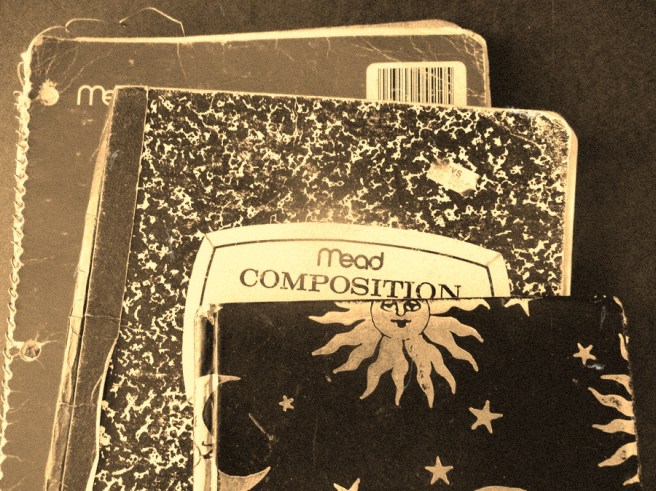
Having started writing poetry long before I ever owned an iPhone, tablet, or even a computer, I have accumulated a massive collection of old notebooks and journals filled with poems and random thoughts I have penned throughout the years. Every once in a while, (especially when I am at a loss for new ideas), I will grab one at random, and reread it. This is a practice I would highly recommend for every writer. Though this act can be a bit embarrassing, by revisiting your past words, you can track your progress as a writer. You also might even rediscover some hidden gem that you wrote but totally forgot about. Recently I found a fragment of an unfinished poem that I was able to rewrite and resurrect as a piece I am now quite proud of. But more often, I will find poems that make me squirm when I read them now, stuff that I have no idea what to do with. So here is my brainstorm: why not publish them on this blog?

Here is one that I just unearthed the other day. I never got in the habit of dating my work, but my guesstimate would be that it is from the mid-1990s, detecting some influence from slam poetry I was listening to back then. I can’t say if I feel it is bad or good, but one thing, it is certainly something I would never write today. Please let me know in the comments what you think.

Old Man on the Street

On a city sidewalk,
where eye contact
can be a punishable offence,
he still smiles at passing strangers
who analyze his motives,
and question his character.

Sometimes a pretty passerby
will toss the old man a look.
Sometimes he steals one uninvited,
gazing openly at smooth lips
and vacuous blue eyes.

He has been warned
the streets are no place
for social situations,
people are too condensed,
too concerned with just
coming and going,
there are more appropriate arenas
to make friends or acquire acquaintances.
But the street is now the only p!ace,
this old man knows.

In the frigid afternoon,
a college boy (wearing
an unreadable expression)
hands him his leftover coffee,
saying human interaction
is an old fashioned concept,
that hip people today meet
on the internet falling in love
over miles and miles of fiber optic cable.

The old man knows when he is being
told a joke, and smiles with jagged teeth.
The boy returns his gesture,
and will again the next time they pass.
Perhaps a smile, not microtechnology,
is still enough to dissolve the curse
of being alone and lonely.

Free Verse Versus Form Poetry

Although I often write in free verse, I have a certain fondness for poetry forms, not only the standard, well-known ones like sonnets, haikus, and sestinas, but especially the weird and obscure like the minute and alphabet poems. In fact, my obsession with them has gone so far, I have repeatedly invented my own.

I am pretty sure you already know what a poetry form is, but recently while conversing with a seasoned poet I never met before at a local open poetry reading, I was shocked to discover that she had no clue what I was talking about. So just in case, you are like that particular lady, form poetry is simply a type of poem (like the previously mentioned sonnets, haikus, and sestinas) that has a distinct set of rules regarding how the poem is to be written, such as the lengths of line, the number of lines and stanzas, subject matter, etc.

When I was teaching poetry workshops for children in libraries and elementary schools, I would often compare writing free verse and form poetry with free play or playing a game such as hopscotch or tic-tac-toe. One is play that is only restricted by your imagination, and the other has a set of rules which you need to follow. Both can be extremely fun, it all depends on what type of play you are in the mood at the time.

Many poets have told me that they could never write a form poem, that they would find it much too difficult and restricting. Yet I actually feel the opposite to be true. For me, it can much easier to follow the rules of a poetry form, which liberates me from having to make such needling decisions as how long to make the lines, or how many lines or stanzas to write. Rhyming too can be freeing, limiting your choice of words at the end of your lines, instead of forcing you to choose the perfect word from almost infinite possibilities.

If you have never tried writing poetry forms before, please give it a try. It is not as daunting as you might think, and you just might enjoy the process. To that end, in my next blog post, I plan to introduce you to a brand new poetry form, one that I invented myself….

The Playground Is Open For Play….

I don’t want this to be a site where I just publish my own poems, but a place to celebrate this literary art form that I (and presumably you) love so much. I plan to discuss different aspects of poetry, talk about both favorite and newly discovered poets, share my experience on writing and getting published, and introduce you to some invented poetry forms I have discovered, and even created.

Although I have been writing poetry for most of my life, and have published many prior blogs on a a variety of subjects (gargoyles, street art, vintage matchboxes, playing cards, etc.), this is my first attempt at combining both interests and creating a poetry blog.

I always thought of poetry as a form of play, so this blog is an invitation for you to join me and come play with some of my favorite toys: words and verse.

Hope to see you back soon!