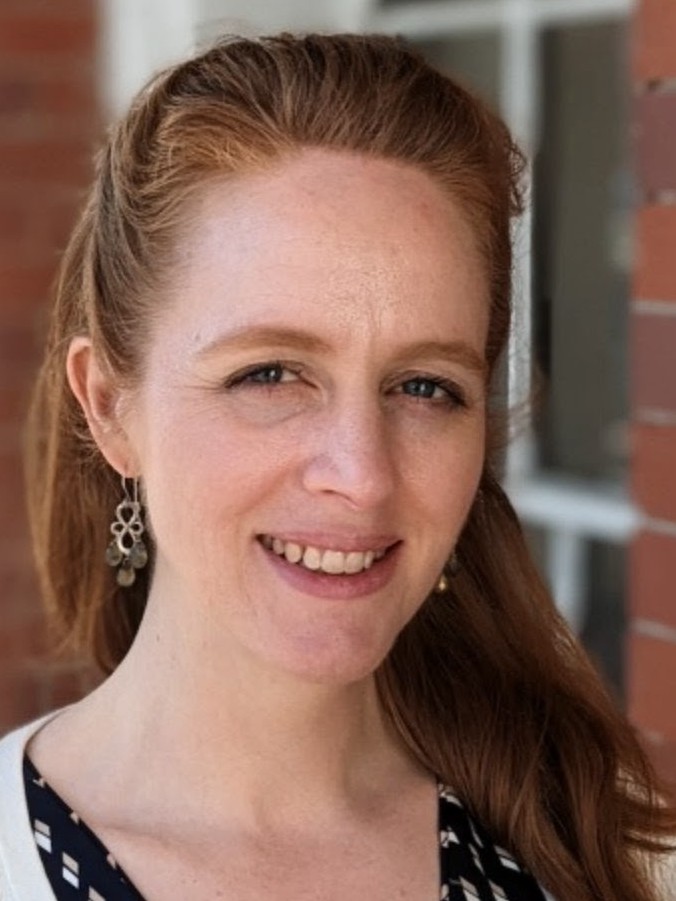
An “International Imaginarium For Word & Verse” Interview With Poet Kate Gregoire

Today’s post is an interview with poet Kate Gregoire that was originally published a little under two years ago in the July 29th, 2024 edition of The International Imaginarium For Word & Verse (I hope you will enjoy reading it)…

An”International Imaginarium For Word & Verse” Interview With Poet Kate Gregoire

Kate Gregoire is an extremely talented poet and writer who lives and writes in Grafton, Massachusetts. Her poetry covers themes of motherhood, ecospirituality, and incantation. She serves on the board of the Worcester County Poetry Association and organized the Rain Poetry project. She is also an editor of Worcester County’s literary journal, The Three Decker. You can find her work on Instagram @katherinegregoirepoet and at local open mics in central Massachusetts.

PAUL: Kate, before we begin the interview, could you please tell us a little bit about yourself?

KATE: I am a poet and mother. It feels like another lifetime ago when I was teaching German language and literature full-time at university. Now I am in a supportive role of raising my little girl, supporting my husband’s ministry, and volunteering for the Worcester County Poetry Association. I’ve attended some 30+ weddings in this post-covid era with my husband and wrote a collection of poems about this experience called “Plus One“. Another collection is in process, inspired by my initiation into motherhood. What feels most pressing, however, is my work towards a collection of alchemical incantations in poetic form that will contribute to healing the relationship between man and nature.

PAUL: I had no idea that you taught German at University. Have you ever written poetry in German? If so, what do you feel are the differences between composing poetry in German and English? Also do you have a favorite German poet?

KATE: What a lovely question! Yes, I have written poetry in German! Our voice in each language we write is the product of our experiences in that language. Much of my German experience is reading the classic works of that language and engaging in discussions about it with fiercely bright and eager students. When composing, I feel those influences teeming at the surface, supplying me with words, phrases, metaphor. Annette von Droste-Hülshoff, a 19th-century writer perhaps better known for her novellas, has an incredible ability to build atmosphere in her poems. I feel an affinity with the playful Mascha Kalèko, a popular poet of the 1930s, and of course Rilke, whose intense spirituality encourages and comforts me.

PAUL: How were you first exposed to poetry?

KATE: I can’t say, exactly. My first memory of reading poetry was in high school, when I was asked to read Wilfred Owen’s “Dulce et Decorum Est” aloud in class. My father was in the military and reading that poem out loud, I was pulled into the moment “quick boys!”.

PAUL: Can you tell us about some of your favorite poets & their poems and the reasons why you like them?

KATE: Oh, there are a great many. I think of Ted Kooser’s “Dandelion”, a completely unassuming poem about a ubiquitous flower, and his ability to infuse that moment ofseeing with such meaning and encouragement. I’ll never look at dandelions the same. Mary Oliver’s “Wild Geese” is another poem that returns again and again to me, each time imparting a different message. She is another unassuming poet who gives comfort by connecting human experiences like loneliness or feeling lost with the divine natural world around us. I’ve read that she worked to be so precise with her writing, it’s something I strive for in my own writing.

PAUL: How has your writing style changed and progressed throughout the years?

KATE: In the early days of writing, my work was terse and rough, but I began my study of poetry in earnest in 2018 when I checked out Mark Strand and Eavan Boland’s book on poetic form The Making of a Poem. I started working my way through it, practicing the standard forms. Writing with a mind to end rhyme, to repetition, to meter, I find it gives your inner voice extra tools for when that poetic inspiration strikes. I’ve been working towards precision, towards clarity lately, though I’m sensing a desire to return to greater opacity, more intense work with metaphor.Always, though, I write with a mind for rhythm and texture in a poem.

PAUL: What do you feel is your primary motivation to write poetry?

KATE:: I was in a climbing accident in 2018, and that brush with mortality made two things clear to me: I regretted not having started a family and I regretted not taking my poetry seriously. That intuition has served as my primary motivation in these early years of becoming a poet; I’m beginning to understand better now to what purpose as I continue to build a community of poetry around myself.

PAUL: What is your own personal definition of poetry?

KATE: Poetry for me is a still frame, a snapshot of life. It is a collection of words that has the power to pull its reader into the moment it describes and declare a connection.

PAUL: What do you feel are the most vital aspects of poetry (imagery, rhythm, word choice, etc)?

KATE: There is a poem out there for everyone! I need to feel a proper rhythm to the words, I enjoy the texture of alliteration and assonance, I enjoy the incantational quality of repetition, and I love word play!

PAUL: How would you describe the poetry you are currently writing?

KATE: My writing today is very much influenced by my first year of motherhood and my struggle to make sense of this intense experience. Aspirationally, I want to encourage the eco-conscience within my writing and explore the power of words to catalyze change. What if a poem read as a prayer sent out into the world with the power to heal the rift between humans and the natural environment? This project pairs surprisingly well with motherhood, as my daughter takes greater and greater interest in words and naming the natural world around her.

PAUL: Do you recall the first poem you ever wrote? If so, is it possible for you to share it with us now?

KATE: The first poem I ever wrote must have been in early elementary, a few lines musing about what I would become. It had a sweet little ending: “I really wonder!”

PAUL: Have you developed a regular writing routine, and if so, can you describe it to us?

KATE: I’ve had the very real privilege of journeying through Julia Cameron’s The Artist’s Way with two different groups of very close friends in the last three years. I call it a privilege, because the book encourages intense and often painful self-examination that was made easier for me in this supportive group setting. My writing practice has developed through this experience of writing daily pages that then transition into poetic sketches. Sometimes it’s just a little play, rhyming words, stream of consciousness, perspective work, and sometimes I’m surprised by a deluge of words that feel very much like a finished poem. My work in progress is making consistent time to edit and submit my work. I make time to read poetry most days, collections, journals. My husband and I love visiting a good bookstore to see whether a volume will catch our eye. I’ve got a few I’m working through at the moment. Lastly, I meet weekly with two very good friends I met in an online poetry class offered by Driftwood Press in 2021, and we support each other in our ups and downs of writing. We meet monthly with a larger group to workshop our poems.The discussions that come from these meetings are absolutely vital to my poetry practice.

PAUL: What is your actual writing process like, and how do you go about starting and shaping a poem?

KATE: I carry a journal with me all the time (a Leuchtturm 1917 A4 Bullet Journal) to catch what I call “poetry bids”, as in bids for my attention. If I’ve got a few minutes, I’ll sketch the rough draft as soon as inspiration strikes. If not, I’ll make a note and chew on the idea while I’m tidying up or out on a walk. Sometimes there’s an idea that needs a strong metaphor. Those usually take a week of “chewing” before I’m ready to commit the idea to paper. I write in pencil, for the haptic quality of the scratch of graphite on the page, but also to disencumber the latent perfectionist in me worried about making mistakes in pen. I happily cross things out and write away. I find setting a timer for 15 minutes helpful for keeping me focused and continuing to probe the idea for more. I’ll type up a poem that continues to haunt me after that and make edits, saving each draft as I go. I check line breaks, word choice, and make cuts before taking a piece to workshop.

PAUL: What advice would you give to someone who is just starting to write poetry?

KATE: Write every day, not to write a poem, but for the sheer joy of writing and playing with words and form. If you make time every day, or most days, to play at and practice your craft, you’ll be ready to catch that poem when inspiration strikes. Be sure to read as much as you can, it’s hard to write from an empty well; and be sure to make time to let your mind wander.

PAUL: My final question of the evening is there any question that you would like to answer about your life, or poetry, or anything else that I have failed to ask you during this interview?

KATE: Once I finally asked myself who I wanted to write poetry for, the poems came more easily, and I began to share them with my friends.
The Latest Edition of the International Imaginarium For Word & Verse (July 29th, 2024)…

Dear Readers,

Believe it ot not, this blog, Paul’s Poetry Playground, is not the only poetry-related project that I have seriously neglected for an inexcusably long time.. Readers may remember The International Imaginarium for Word & Verse, a rather unique online poetry journal which takes the form of a transcript of an imaginary poetry reading which I’ve posted links to past edition here on this blog.. Well, after more than a whole year in the making (I started putting it together last September with an announced publication date this May which I later postponed to June),  here is finally the link to the latest edition featuring the incredibly talented poet Katherine Gregoire, which was eventually posted at the very end of this July on our Imaginarium website for you to hopefully peruse and enjoy at your leisure:.

I want to thank my fellow blogger Diane Puterbaugh, along with all the other amazing poets who participated in our Imaginarium virtual open mic.  Like previous times, I have decided not to repost the entire Imaginarium here on this blog because I feel that it is probably too long a read and thus far too overwhelming for most of my readers (as a result, some really excellent poetry might be skipped, and that would be a real shame). So instead, I will just post this month’s Imaginarium group poem (which is probably one of my favorite segments of the Imaginarium). This month’s Imaginarium Group poem was based on the surrealist game of Prophecies (also known as Conditionals). Participants were asked to write and send us four lines including one each of the following:

1. A short phrase in the present tense starting with the word “When” such as “When the oceans begin to boil,”.

2. A short phrase in the present tense starting with the word “If” such as “If your right elbow itches,” .

3. A short statement in the future tense using either the word “will” or “shall” such as “The President will sprout horns.” or “Hamsters shall rule the world.” .

4. A command written in the imperative such as “Lock the doors and hide beneath your bed”.

People‘s lines from 1 & 2 were then randomly paired with someone else’s lines from 3 & 4 to form brand new lines for our poem. Six folks (including myself) contributed with the results being the following poem:

Weird Prophecies and Strange Advice From the Imaginarium

When you find yourself alone in a dark alley,
reconsider your options.

When it rains Swedish Fish,
new insights will evaporate old science.

When the Aurochs mate in the shade of ginkgo trees,
that nor’easter from last January will circle back
declaring I am a mandala made of wind.

When the sea shells end their ceaseless rhetoric,
heave your answers against the echoing hills.

When water molecules can fracture and fly off into clouds,
you will read me a book about time.

When salmon swim upstream carrying salmonella,
then all that was lost will be lost again.

If the angle of descent is too steep,
wear a red shirt to camouflage the blood.

If photons of light strike with perfect angle,
look at the pages of a beloved book and rejoice!

If the crabs and oysters line up in alphabetical order,
the Florida peninsula will break off and sink to the bottom of the sea.

If children’s books become real,
report any abnormalities to your physician.

If the clouds spill their blood,
you will be disappointed.

If you want to live to see another day,
rethink those suspect equations and maybe SAVE us…

—The July 2024 International Imaginarium Group Poem

I want to thank Ariel Potter, Diane Puterbaugh, Brian Mosher, Howard Kogan, and Karen Durlach for contributing and making the preceding poem possible.

The International Imaginarium For Word & Verse (May 3rd, 2023)

Dear Readers,

I must apologize for the eternity it has taken, but here is finally the link to the latest edition of The International Imaginarium for Word & Verse featuring the incredibly talented poet Padmaja Battani posted last Wednesday night on our Imaginarium website for you to hopefully peruse and enjoy at your leisure:.

I want to thank my fellow bloggers Angela Wilson (AKA poetisatinta), and (Gypsie) Ami Offenbacher-Ferris for graciously accepting my invitation to participate which I previously posted on this blog. Like previous times, I have decided not to repost the entire Imaginarium here on this blog as I have often done with the editions of the Virtual Poetorium because I feel that it is probably too long a read and thus far too overwhelming for most of my readers (as a result, some really excellent poetry might be skipped, and that would be a real shame). So instead, I will just post this month’s Imaginarium group poem (which is probably one of my favorite segments of both the Poetorium and the Imaginarium). You might recall we have often rewrote the classic Wallace Steven poem “Thirteen Ways of Looking at a Blackbird” as our group poem in the past, but substituting other things for the blackbirds such as umbrellas and dandelions This month, we once again used that classic poem as a template, but this time we used manhole covers as our subject. The way it worked was all our participants sent us one to eight lines containing either the phrase “manhole cover” or “manhole covers”, and then all contributions were numbered and compiled into a poem entitled “Seven Different Ways of Looking at a Manhole Cover”. I want to thank Robert Eugene Perry, Howard J Kogan, Angela (aka Poetisatinta), Tim McCarthy, and the others who wish to remain anonymous for contributing and making the preceding poem possible (Angela’s contribution can be found published as an individual poem on her website Let’s Write…)…

Seven Different Ways to Look at a Manhole Cover

I.
Among the busy city streets
The only things not moving
Were the manhole covers.

II.
My mind was split thricely
Like manholes
On three divided streets

III.
From below the manhole cover
Appears to be the gate of the overworld,
From above, the underworld.
Are heaven and hell separated
By the steel disc of a manhole cover
Or are they connected?

IV.
Among the concrete slabs
The only circle I see
Is that of the manhole cover
It holds back gravity
Concealing a black hole
Squeezed into this space
Beneath a manhole cover.

V.
He rode over a manhole cover
In an old car
He dreamed of manhole covers for weeks.

VI.
I have often mistaken manhole covers
For subway tokens of the Gods
Or Superman’s rusty Frisbee.

VII.
There once was a missing manhole cover.
At which a curious fellow would hover
He fell into the murky mucky dark hole
As he lost all control,
“Mercy me” he cried to discover his lover.

—The International Imaginarium Group Poem for May 3rd, 2023

Attention: The First International Imaginarium For Word & Verse of 2023 Has Been Postponed…

Dear Readers,

I have some bad news and good news concerning our first edition of The International Imaginarium For Word & Verse for 2023 (featuring Padmaja Battani) previously scheduled to be posted on the Imaginarium website this evening. The bad news is that I tested positive for COVID this Thursday, and consequentially am not in shape to finish the Imaginarium in time for tonight and will have to postpone it until I am feeling better (currently, I’m suffering from both low energy and brain fog which makes the task nearly impossible). I am not exactly sure when that will be, but I hope to have this edition of the Imaginarium out sometime by mid-April. The good news is that if you wanted to participate but could not make the deadline, you now can. I am now once again accepting contributions until Saturday, April 8th. Thank you so much for understanding and hope you will take advantage of this extended opportunity to contribute to our latest edition of the Imaginarium…

An Invitation to Participate in the First International Imaginarium For Word & Verse of 2023…

Dear Readers,

I’m happy to announce that The International Imaginarium For Word & Verse is finally back from its five-month hiatus this month and would like to invite all of you to participate in our fourth edition (our very first one for this year) with Padmaja Battani, a very talented poet, and writer living in Connecticut, as our featured poet to be posted on our Imaginarium website on the evening of Tuesday, March 28th, 2023.

To be part of our Imaginarium open mic this month, please send us one to three of your own original poems or stories (under 2000 words altogether please) either in a Word document file or pasted in the body of an email along with your name, any opening remarks you care to make, and where your poem has appeared if it was previously published to poetorium@mail.com by Friday, March, March 24th. Also if you like, you can send us a photo of yourself to be posted above your poem, but that is totally optional.

We also need contributions to this month’s Imaginarium Group poem. This month, we are going back to something we previously tried twice before with the Poetorium group poem, and use the classic Wallace Steven poem “Thirteen Ways of Looking at a Blackbird” as our poem’s template, but this time substituting the phrase “manhole cover” for “blackbird”. So to participate, please send us one to eight lines containing either the phrase “manhole cover” or “manhole covers”. Your contributions (which like always will remain anonymous unless otherwise requested) will then be numbered and compiled into this month’s group poem which will be tentatively entitled “Different Ways of Looking at a Manhole Cover” Once again, the deadline to contribute will be Friday, March 24th.

If you have any questions about submitting to the virtual open mic, the group Imaginarium poem, or anything else about the International Imaginarium For Word & Verse itself, please leave them in the comments of this post, and I will try to answer them right away.

Thank you so very much for reading, folks! As always, I really appreciate everyone’s continued support of this blog, and hope to hear from you soon with your contributions to our fourth edition of the International Imaginarium!

The International Imaginarium For Word & Verse (November 29th, 2022)

Dear Readers,

Here is the link to the very last edition of The International Imaginarium for Word & Verse for the year 2022 featuring the incredible 2021 Stanley Kunitz Medal-winning poet Eve Rifkah posted last Tuesday night on our new Imaginarium website for you to hopefully peruse and enjoy at your leisure.

I want to thank my fellow bloggers John Ormsby,  Angela Wilson (AKA poetisatinta), and (Gypsie) Ami Offenbacher-Ferris for graciously accepting my invitation to participate which I previously posted on this blog. Like last time, I have decided not to repost the entire Imaginarium here on this blog as I have often done with previous editions of the Virtual Poetorium because I feel that it is probably too long a read and thus far too overwhelming for most of my readers (as a result, some really excellent poetry might be skipped, and that would be a real shame). So instead, I will just post this month’s Imaginarium group poem (which is probably one of my favorite segments of both the Poetorium and the Imaginarium). Since this was our last group poem of the year, the theme is fittingly the year 2022. Contributors were asked to send us one to a dozen lines beginning with either “This was the year of…” or “This was the year that…”. All contributions we received were then compiled and included in this month’s Imaginarium Group Poem. I want to thank Howard J Kogan, Karen Durlach, and Angela Wilson (AKA Poetisatinta) for participating and making the following poem possible (Angela’s contribution can be found published as an individual poem on her website Let’s Write…)…

The Year 2022

This was the year the threatened
Red Tide happily died at sea.

This was the year we stopped
mentioning his name,
people even gave up Bridge.

This was the year of discovery and recovery
but for some, a year of death and misery
a year of hypocrisy, invasion, and migration
of numerous variants and vast inflation
while we observed the effects of climate alteration
and now there’s controversy with the World Cup situation.
In the UK we had a glut of Prime Ministers
and the cost of electricity is bleeding us dry
there was joy in June celebrating the jubilee
but tears within months when we had to say goodbye
as a nation we joined together in the mourning
but now we have hope with the rise of a king.

This was the year of 8 billion
8 billion sets of hopes and dreams
8 billion sets of needs and wants and hungers.
Gaia tipped over, spilled tears of blood,
of flood, dry tears of drought,
melting ice, enflamed with fires, war.
8 billion thinking themselves autonomous,
each filled with billions more microbes,
bacterias, viruses, fungi, living in symbiosis,
more resilient than the vessels,
poised to evolve again.

—The International Imaginarium Group Poem for November 29th, 2022

An Invitation to Participate in the Final International Imaginarium For Word & Verse of 2022…

Dear Readers,

I’d like to invite you all to participate in what will be our very last International Imaginarium For Word & Verse of 2022 featuring the 2021 Stanley Kunitz Medal-winning poet, Eve Rifkah (I’d love to have a Christmas-themed Imaginarium this December like we did with the Virtual Ho-Ho-Etorium last year and the year before, but unfortunately I don’t think I‘ll have the time during this hectic holiday season) that I will be posting on the Imaginarium website on the evening of Tuesday, November 29th. To be part of our Imaginarium open mic, please send up to three of your own original poems or stories (they can be Thanksgiving, Christmas, or New Year-themed or no particular theme at all, whatever you like to share) either in a Word document file or pasted in the body of an email along with your name, any opening remarks you care to make, and where your poem has appeared if it was previously published to poetorium@mail.com by Sunday, November 27th. Also if you like, you can send us a photo of yourself to be posted above your poem or story, but that is totally optional.

Like always, we also need contributions to this month’s Imaginarium group poem. Since this will be our last group poem of the year, the theme will fittingly be the year 2022, so please send us one to a dozen lines beginning with either “This was the year of…” or “This was the year that…”. All contributions (which will remain anonymous unless otherwise requested) will be compiled and included in this month’s Imaginarium Group Poem to be tentatively titled “2022″. Once again, the deadline for submissions is the night of Sunday, November 27th, 2022.

If you have any questions about submitting to the virtual open mic, the group Imaginarium poem, or anything else about the International Imaginarium For Word & Verse itself, please leave them in the comments of this post, and I will try to answer them right away.

If you’ve been meaning to participate in the Imaginarium, but have been putting it off, please keep in mind this will be your last chance this year. As always, I appreciate everyone’s continued support of this blog. I hope to hear from you soon with your contributions to the last edition of the International Imaginarium of 2022! Thank you so much for reading, and have a fabulous Thanksgiving, folks!

The Halloween Edition of The International Imaginarium For Word & Verse (October 25th, 2022)

Dear Readers,

Here is the link to the Halloween edition of The International Imaginarium for Word & Verse posted last Tuesday night on our new Imaginarium website for you to hopefully peruse and enjoy at your leisure: https://internationalimaginarium.blogspot.com/2022/10/the-halloween-edition-of-international.html

I want to thank my fellow bloggers A. J. Wilson (AKA poetisatinta), and Tom Ewart (AKA tommywart) for graciously accepting my invitation to participate which I previously posted on this blog. Although the Imaginarium ended up being much shorter than usual, I decided not to repost the entire Imaginarium here on this blog as I have often done with previous editions of the Virtual Poetorium because I feel that it is probably still too long a read, and thus far too overwhelming for most of my readers (as a result, some really excellent poetry might be skipped, and that would be a real shame). So instead, I will just post this month’s Imaginarium group poem (which is probably one of my favorite segments of both the Poetorium and the Imaginarium). This month, we requested people to send us one to eight lines starting with the phrase “Halloween is…” All contributions were then compiled into the following poem which I’m afraid. like the entire Imaginarium, is also rather shorter than usual this month since we only received submissions from just Karen Durlach and A. J. Wilson (aka poetisatinta) besides myself (I hope you enjoy reading it!)…

Just What Is This Thing Called Halloween?

Halloween is the night of scary things
of witches’ brews and flying brooms
of hissing cats and screeching bats
of chills and mists that pierce the soul
and whispering winds that keep you cold
so stay alert, away from witchy spells
then you’ll be safe from the hounds of hell.

Halloween is hanging
by a thread, from a web,
the rattle of bone, in the dark, alone,
a fluttery sheet that has no feet,
a headless hat, a phantom cat,
a spooky night, such a fright delight.

Halloween is a holiday marked by the consumption
Of confection, commercialism crass as Christmas,
A celebration of contradictions when the so-called innocent don masks
to extort the neighborhood, where the ominous and the whimsical
Dance cheek to cheek at a costume ball, and you never know
Either to expect a sack of candy corn or a bag of human bones.

—The October 2022 Imaginarium Halloween Group Poem

An Invitation to Participate in a Special Halloween-Themed International Imaginarium For Word & Verse For October 25th, 2022

Dear Readers,

After mulling it over for a few days, I am very pleased to announce that, in spite of having a very hectic schedule filled with numerous poetry events this month (including our live Poetorium at Starlite show on October 27th in Southbridge, Massachusetts), I will be producing a special Halloween-themed edition of the International Imaginarium For Word & Verse (which I am tentatively dubbing the Scarynarium) and would like to open it for anyone who would like to participate, inviting all my fellow bloggers and faithful readers (or just anyone just happening to read this) to be a part of it. Unlike a regular edition, there will be no featured poet but instead will have an extra-long open mic to be divided into two sections. Because of this, we are requesting that you send us up to three of your own original poems or stories (ones that are scary or have a Halloween theme are preferred though not required) either in a Word document file or pasted in the body of an email along with your name, any opening remarks you care to make, and where your poem has appeared if it was previously published to poetorium@mail.com by Sunday, October 23rd. Also if you like, you can send us a photo of yourself (extra brownie points rewarded if you are in costume) to be posted above your poem, but that is totally optional.

Like always, we also need contributions to this month’s Imaginarium Group poem. To participate, please send us one to eight lines starting with the phrase “Halloween is… “. All contributions (which will remain anonymous unless otherwise requested) will be compiled and included in this month’s Halloween edition of the Imaginarium Group Poem. Once again, the deadline for submissions is the night of Sunday, October 23rd.

We will also be reviving (at least for this month) the monthly writing challenge which we once did with the Virtual Poetorium where we invited you to write in a different flash fiction or poetic form each month. This month’s challenge will be to write a six-word story (your story can include a title or not, the choice is up to you), and once again, a Halloween theme is suggested. In case you are not familiar with this popular flash fiction form, you can read about how to write one @ https://www.masterclass.com/articles/how-to-write-an-unforgettable-six-word-story#3-examples-of-sixword-stories. Please send us your best efforts by Sunday, October 23rd to be included in this month’s Halloween-themed Imaginarium.

Also if you wish, please feel free to send us any of your own original scary or Halloween-themed artwork or photos to be displayed and shared during our virtual intermission! Our new Imaginarium website has the ability to embed videos, so if you have any links to any scary or Halloween-themed videos you have created hosted on YouTube or other sites, please feel free to send them to us as well.

If you have any questions about submitting to the virtual open mic, the group Imaginarium poem, or anything else about the International Imaginarium itself, please drop us a line, and we will try to answer them right away.

Thank you so very much, my dear friends! We really appreciate your help and look forward to your participation. Please take care, and stay safe, but try to have a very scary but fun October!

The International Imaginarium For Word & Verse For September 27th, 2022

Dear Readers,

Here is the link to the second first edition of The International Imaginarium for Word & Verse (which is the new name for The Virtual Poetorium) with the multi-talented writer, poet, lyricist, playwright and theatrical director James B. Nicola from New York City as the featured poet posted last Tuesday night on our brand new Imaginarium website for you to hopefully peruse and enjoy at your leisure: https://internationalimaginarium.blogspot.com/2022/09/international-imaginarium-for-word.html

I want to thank my fellow bloggers John Ormsby, Diane Puterbaugh, Angela Wilson (AKA poetisatinta), and Tom Ewart (AKA tommywart) for graciously accepting my invitation to participate which I previously posted on this blog. Like last time, I have decided not to repost the entire Imaginarium here on this blog as I have often done with previous editions of the Virtual Poetorium because I feel that it is probably too long a read and thus far too overwhelming for most of my readers (as a result, some really excellent poetry might be skipped, and that would be a real shame). So instead, I will just post this month’s Imaginarium group poem (which is probably one of my favorite segments of both the Poetorium and the Imaginarium). This month, we did a variation of what we did for our Poetorium group poem in September 2019, but instead of asking people to contribute a few lines of “something a true poet would never say”, we asked them to do the opposite and send us one to eight lines of “things only a real poet would say”. All contributions we received were then compiled and included in this month’s Imaginarium Group Poem. I want to thank Robert Eugene Perry, John Ormsby, Howard J Kogan, Karen Durlach, and Angela Wilson (AKA Poetisatinta) as well as other contributors who wish to remain anonymous for participating and making the following poem possible (both John’s and Angela’s contributions can be found published as individual poems on their respective websites Mr. Ormsby at Large and Let’s Write…):

Eight Things Only a Real Poet Would Say…

I.
Love is eternal regardless of what life draws in
Indeed, when we hold it at arm’s length
It will eventually find its home again
A ceaseless feeling that may rip you apart
But the beauty of both love and a poem
Is they are found in the heart.

II.
The heart is a church with broken windows.

III.
A metaphor is a revolving door
That brings you back to where you were before.

IV.
This is just to say
I have eaten all the words
You had strewn across the page
They were delightful
So full of life,
As am I.

V.
You see a marble
I see the moon
You hear a garble
I hear a tune
You hold me closer
Without a sound
I’m life’s composer
Noting it down

VI.
In regards to writing poetry,
The money does not matter…

VII.
The things only a real poet would say are lies
And only real poets spout the gods’ truth.
When the parrot poets, the mocking birds, and the mourning doves
Taught the apes to sing and dance,
Channel thought into word, thrum air into verse,
Then all born would be poets, sharing stories,
Forwards and backwards and inside out,
Truth and lies, lies and truth.

VIII.
When we first began to write,
We were all convinced we would save
The Universe with our verse.
Then later we thought we would be
the ones to rescue poetry from the world.
But now in the final stanza, we, at last, realize
It was, in fact, the poetry that saved us all…

—The International Imaginarium Group Poem for September 27th, 2022