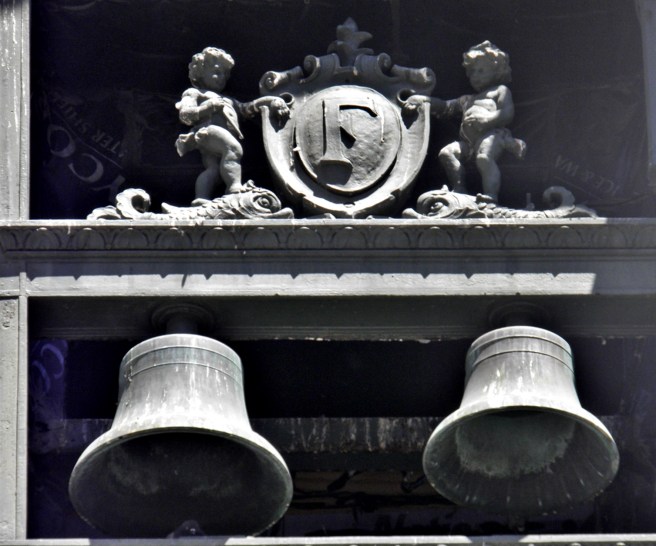
 As I explained in an earlier post, a lipogram is simply writing in which the author excludes one or more specific letters of the alphabet. Although lipograms can be totally original works (examples include the novels “Gadsby” by Ernest Vincent Wright and “Lost and Found” by Andy West which both omit the letter e), I am particularly fascinated by the variation where pre-existing texts are rewritten in the form. Last time, I shared my lipogram of the Robert Frost poem ” Fire and Ice” without any i’s entitled “Flame and Frozen Water” . This time I have attempted to revise the first section of the Edgar Allen Poe classic poem” The Bells” by avoiding the most frequently used letter in the English language – e (I am still working on converting the other three). First here is the original:
The Bells
I.
Hear the sledges with the bells—
Silver bells!
What a world of merriment their melody foretells!
How they tinkle, tinkle, tinkle,
In the icy air of night!
While the stars that oversprinkle
All the heavens, seem to twinkle
With a crystalline delight;
Keeping time, time, time,
In a sort of Runic rhyme,
To the tintinabulation that so musically wells
From the bells, bells, bells, bells,
Bells, bells, bells—
From the jingling and the tinkling of the bells.
— Edgar Allen Poe
I had an extremely difficult time finding a synonym for bells that did not include the letter e. My first inclination was to rewrite the poem as “Gongs”, but instead I settled on an instrument quite different but often utilized in modern days for the same purposes that bells served in Poe’s time:
Horns
I.
Hark! Cars and trucks with horns —
Honking horns!
What a world of mishaps this cacophony forwarns!
How that blaring, blaring, blaring
In this humid air of day
With a blazing sun glaring
And human ill humor flaring
Into a rowdy, frantic fray;
Sustaining rhythm, rhythm, rhythm
In a sonic sort of schism
From a sad symphony of traffic that moans and mourns
With car horns, horns, horns, horns,
Horns, horns, horns —
With this tooting and that hooting of car horns!
So what do you think, folks? Was my lipogram successful in retaining the style and flavor of the original? Perhaps my humble effort inspired you to try writing one of your own? Which classic poem would you like to see recreated sans a certain letter? If you do try your hand at one, I hope you will share it with us.
 My good friend and fellow poet, Joan Erickson, recently emailed me to let me know that while perusing this blog, she read my post on clerihews, and decided to try writing a few of her own. She included the three that she wrote in her email, then a few days later (apparently still in the grip of clerihew fever) sent me two additional ones. I thought all five captured the spirit of the form splendidly, so I have asked her kind permission to publish them here, which she graciously granted. I hope you will enjoy them as much as I have:
 The name of this form is fairly self-explanatory. An acrostic selfie poem is a short, usually whimsical self portrait in verse, in which the first letter of each line spells out the poet’s name. I can’t actually say who first invented the form since the acrostic name poem goes back at least to the Middle Ages, but I first utilized the concept myself about 15 years ago while teaching a poetry workshop for children at the public library in Sterling, MA. If a poet is feeling ambitious, one can use their full legal name, but it is quite acceptable to settle just for your first name like I did when I wrote the following example as a model for my students (I hope you will enjoy reading it and that it will inspire you to try writing your very own):