One More Lipogram…

OLYMPUS DIGITAL CAMERAAs I explained in an earlier post, a lipogram is simply writing in which the author excludes one or more specific letters of the alphabet. Although lipograms can be totally original works (examples include the novels “Gadsby” by Ernest Vincent Wright and “Lost and Found” by Andy West which both omit the letter e), I am particularly fascinated by the variation where pre-existing texts are rewritten in the form. Last time, I shared my lipogram of the Robert Frost poem ” Fire and Ice”  without any i’s entitled “Flame and Frozen Water” .  This time I have attempted to revise the first section of the Edgar Allen Poe classic  poem” The Bells”  by avoiding the most frequently used letter in the English language – e  (I am still working on converting the other three). First here is the original:

The Bells

I.
Hear the sledges with the bells—
Silver bells!
What a world of merriment their melody foretells!
How they tinkle, tinkle, tinkle,
In the icy air of night!
While the stars that oversprinkle
All the heavens, seem to twinkle
With a crystalline delight;
Keeping time, time, time,
In a sort of Runic rhyme,
To the tintinabulation that so musically wells
From the bells, bells, bells, bells,
Bells, bells, bells—
From the jingling and the tinkling of the bells.

— Edgar Allen Poe

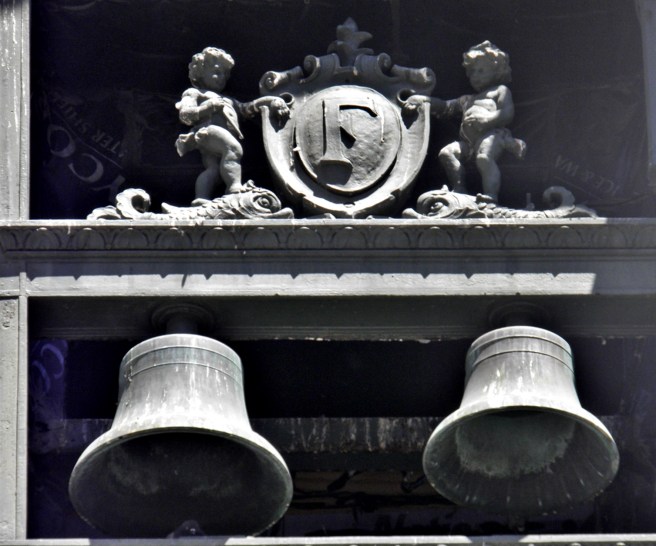
I had an extremely difficult time finding a synonym for bells that did not include the letter e. My first inclination was to rewrite the poem as “Gongs”, but instead I settled on an instrument quite different but often utilized in modern days for the same purposes that bells served in Poe’s time:

Horns

I.
Hark! Cars and trucks with horns —
Honking horns!
What a world of mishaps this cacophony forwarns!
How that blaring, blaring, blaring
In this humid air of day
With a blazing sun glaring
And human ill humor flaring
Into a rowdy, frantic fray;
Sustaining rhythm, rhythm, rhythm
In a sonic sort of schism
From a sad symphony of traffic that moans and mourns
With car horns, horns, horns, horns,
Horns, horns, horns —
With this tooting and that hooting of car horns!

So what do you think, folks? Was my lipogram successful in retaining the style and flavor of the original? Perhaps my humble effort inspired you to try writing one of your own? Which classic poem would you like to see recreated sans a certain letter? If you do try your hand at one, I hope you will share it with us.


Constrained Writing Forms – The Lipogram

118

Instead of my usual presentation of a poetry form, today’s post will be in the same vein, but about a slightly different topic -constrained writing. Interestingly all poetic forms (both invented and traditional) are examples of constrained writing, but not all constrained writing is poetry. It can be applied to different types of writing and all of the literary arts including novels, short stories, essays, song lyrics, speeches and even technical writing. So exactly what is constrained writing? It is a literary technique in which the writer imposes certain rules or limitations on themselves. These limitations can involve subject matter, length (of the words, lines or sentences, or even the whole work itself), order, and vocabulary. Now you are probably already familiar with some of the more common forms – acrostics, anagrams, palindromes, and abecedarians, but today I would like to discuss one you may not be, the lipogram.

The lipogram is simply writing where one or more letter of the alphabet is omitted. Since it would not be not much of a challenge to just leave out rarely-used letters such as X or Z, usually the most frequently-used ones are chosen to be avoided like a vowel (especially E and O) or S and T. Many lipograms are totally original work, but I would like to concentrate on the variation where the writer attempts to recreate a pre-existing text (usually something well known like a famous poem, novel, or play) minus a particular letter. For demonstration purposes, let’s select probably one the most infamous sequence of words in the English language, the first few lines of Hamlet’s soliloquy by William Shakespeare:

To be, or not to be–that is the question:
Whether ’tis nobler in the mind to suffer
The slings and arrows of outrageous fortune
Or to take arms against a sea of troubles
And by opposing end them. To die, to sleep–
No more–

Now let’s try rewriting it without the letter S (at this point, access to a thesaurus would be handy). Here is my own humble attempt:

To be, or not to be–that be the query:
Whether it be nobler in the mind to be attacked by
The catapult and arrow of appalling fortune
Or to wield a weapon in defiance of an ocean of trouble
And by challenging end it. To die, to nap–
No more–

You will notice without an S, I had to sacrifice plurals, and make many other changes. By substituting synonyms for many of the words, the meaning and flavor may been altered (hopefully slightly)as well as the meter and length of the lines, but I have tried to retain the original’s spirit. Okay, let’s do it again, by getting rid of the letter E:

To subsist, or not to subsist–that is my inquiry:
If it is so virtuous in our minds to put up with
Slings and arrows of atrocious fortuity
Or to carry arms against a flood of irritations
And by opposing finish it all. To abandon our mortal coils,
to not snatch forty winks from this point onward –

One nice thing about writing lipograms is that it helps develop your skill in making appropriate word choices. For instance, I originally was going to substitute “pass away” for “sleep”, but decided to go with the longer phrase “abandon our mortal coils” because I felt it sounded more Shakespearean.

Now that you have a basic understanding of the form, it is time for some actual poetry. The following example is my first experiment in writing verse that is a lipogram based on a well-known poem (one of my personal favorites). First here is the original:

Fire and Ice

Some say the world will end in fire,
Some say in ice.
From what I’ve tasted of desire
I hold with those who favor fire.
But if it had to perish twice,
I think I know enough of hate
To say that for destruction ice
Is also great
And would suffice.

–  Robert Frost

And here it is converted into a lipogram by rewriting it without the letter I (while keeping the original rhyme of abaabcbcb):

 Flame and Frozen Water

Some say the world shall end by flame,
Some say by frozen water.
From what we’ve seen of lust and shame,
We’ll stand by those who favor flame.
But should the earth be a double martyr,
We feel we know enough of hate
To say that, yes, frozen water
Too makes a great
Means for slaughter.

So what do think of the lipogram? Is it just a word game, a complete waste of time, or a valid literary form? I personally feel that it is the latter, but I would love to hear your opinion.