10 Great Quotes About Poets, Poetry, and Writing by Amy Lowell

416

“Without poetry the soul and heart of man starves and dies.”

“I do not suppose that anyone not a poet can realize the agony of creating a poem. Every nerve, even every muscle, seems strained to the breaking point. The poem will not be denied; to refuse to write it would be a greater torture. It tears its way out of the brain, splintering and breaking its passage, and leaves that organ in the state of a jelly-fish when the task is done.”

“Poets are always the advance guard of literature; the advance guard of life. It is for this reason that their recognition comes so slowly.”

“I never deny poems when they come; whatever I am doing, whatever I am writing, I lay it aside and attend to the arriving poem.”

“Poetry, far more than fiction, reveals the soul of humanity.”

“Poetry is the most concentrated form of literature; it is the most emotionalized and powerful way in which thought can be presented.”

“Polyphonic prose is a kind of free verse, except that it is still freer. Polyphonic makes full use of cadence, rime, alliteration, assonance.”

“To understand Vers libre, one must abandon all desire to find in it the even rhythm of metrical feet. One must allow the lines to flow as they will when read aloud by an intelligent reader.”

“Don’t ask a writer what he’s working on. It’s like asking someone with cancer on the progress of his disease.”

“God made me a business woman, and I made myself a poet.”

—Amy Lowell

10 Great Quotes About Poets, Poetry, and Writing By Stephen Dobyns

IMG_2486 (3A)

“One writes a poem when one is so taken up by an emotional concept that one is unable to remain silent.”

“Writing is a job, a craft, and you learn it by trying to write every day and by facing the page with humility and gall. And you have to love to read books, all kinds of books, good books. You are not looking for anything in particular; you are just letting stuff seep in.”

“I write poems to find out why I write them.”

“I can’t believe there is a poet who hasn’t eagerly put down a word one day, only to erase it the next day deciding it was sheer lunacy. It’s part of the process of selection.”

“Many of my poems try to use a comic element to reach a place that isn’t comic at all. The comic element works as a surprise. It is unexpected and energizing.”

“My poems always begin with a metaphor, but my way into the metaphor may be a word, an image, even a sound. And I rarely know the nature of the metaphor when I begin to write, but there is an attentiveness that a writer develops, a sudden alertness that is much like the feel of a fish brushing against a hook.”

“A poem is a window that hangs between two or more human beings who otherwise live in darkened rooms.”

“For the past thirty years or so, much American poetry has been marked by an earnestness that rejects the comic. This has nothing to do with seriousness. The comic can be very serious. The trouble with the earnest is that it seeks to be commended. It seeks to be praised for its intention more than for what it is saying.”

“Poetry is a craft that one learns over a long period of time. But you only learn it if certain gifts are there to begin with – an imagination, the ability to make metaphor, a sense of language and rhythm and sound. intelligence, passion, curiosity, a great deal of empathy, and a fire in the belly.”

“Poetry… creates a metaphor, which enables the reader to experience what you have experienced with a kind of specificity and depth that is not possible in casual language, partly because the form also communicates the information.”

— Stephen Dobyns

“Found” American Sentences

OLYMPUS DIGITAL CAMERABeing so gratified by the enthusiastic response to my recent post on the American Sentence (with so many readers trying their own hand at writing one as well as linking that post to their own blogs), I decided to write some more on the subject. Doing research on the net, I discovered the delightful practice of people searching for “found” American sentences buried in a variety of literature such as novels and short stories (thanks to an informative post by Sue Walker on the Negative Capability Press website). So I have attempted mining for some poetic treasure of my own in two classic novels by two of my favorite writers. The following are the results of my literary treasure hunt (with some of the original sentences slightly altered and edited to fit the rules of the American Sentence of 17 syllables being written in a single line as a complete grammatical sentence). First, here are three gorgeous “found” American Sentences written by Ray Bradbury, who I feel may be the most exquisite writer of poetic prose of all time, from his novel Dandelion Wine:

His fingers trembled, bright with blood, like the bits of a strange flag now found
— Ray Bradbury

Birds flickered like skipped stones across the vast inverted pond of heaven
— Ray Bradbury

Bees have a smell, their feet are dusted with spice from a million flowers
— Ray Bradbury

And here are three by Raymond Chandler from his first novel The Big Sleep (the last one might just be my favorite American Sentence ever):

Mid-October is the sun not shining and a look of hard wet rain
—Raymond Chandler

His heart was a brief, uncertain murmur, his thoughts were as gray as ashes
—Raymond Chandler

The old man nodded, as if his neck was afraid of the weight of his head
—Raymond Chandler

So what do you think, dear readers? Are you now inspired to start searching for possible American Sentences in your own favorite books?  I sure hope you are, and if you find any good ones, that you will share your bounty with us all!


10 Great Quotes About Poets, Poetry, and Writing By Samuel Taylor Coleridge

new olympus pictures 234b (4)

“Poetry: the best words in the best order.”

“Works of imagination should be written in very plain language; the more purely imaginative they are, the more necessary it is to be plain.”

“What is an epigram? A dwarfish whole. Its body brevity, and wit its soul.”

“Poetry has been to me its own exceeding great reward; it has given me the habit of wishing to discover the good and beautiful in all that meets and surrounds me.”

“A poet ought not to pick nature’s pocket. Let him borrow, and so borrow as to repay by the very act of borrowing. Examine nature accurately, but write from recollection, and trust more to the imagination than the memory.”

“When a man is unhappy he writes damned bad poetry…”

“Iambics march from short to long;–
With a leap and a bound the swift Anapaests throng.”

“No man was ever yet a great poet, without being at the same time a profound philosopher.”

“Poetry is the blossom and the fragrance of all human knowledge, human thoughts, human passions, emotions, language.”

“Sir, I admit your general rule, That every poet is a fool, But you yourself may serve to show it, That every fool is not a poet.”

—Samuel Taylor Coleridge

Invented Poetry Forms – The American Sentence

IMG_2148 (5)

Today’s post is on the American Sentence, a poetry form invented by the American Beat poet Allen Ginsberg in the mid-1980’s as a twist on traditional haiku. Like haiku, American Sentences consist of 17 syllables, but instead of being arranged into three lines, they are written as a single line or sentence. They also may or may not have a title.

As far as the other rules of the form, there seems to be varying opinions. Many seem to feel the poem should be just one complete grammatical sentence, while others have written them as two, three, or four or even just as series of phrases. Paul E. Nelson (the poet most associated with the American Sentence, besides Ginsberg) emphasizes the use of concrete images though ones written by others often deal with abstractions. Ginsberg, himself, stated that the poem, if possible should mention either a time or place (or both) and the use of articles such as “a” and “the” should be avoided. But even he didn’t always follow the last suggestion as seen in these four of the original American Sentences composed by Ginsberg:

Nov 1991 N.Y.

Put my tie on in a taxi, short of breath, rushing to meditate

—Allen Ginsberg

Tompkins Square Lower East Side N.Y.

Four skinheads stand in the streetlight rain chatting under an umbrella

—Allen Ginsberg

On Hearing the Muezzin Cry Allah Akbar While Visiting the Pythian Oracle at Didyma Toward the End of the Second Millennium

At sunset Apollo’s columns echo with the bawl of the One God

—Allen Ginsberg

Approaching Seoul by Bus in Heavy Rain

Get used to your body, forget you were born, suddenly you got to get out!

—Allen Ginsberg

In comparison, here are four American Sentences that I attempted:

Boulevard Diner

The ham slices squeal on the smoking grill like the ghosts of dying pigs

The Sad Truth About Aging

To grow old is to witness your world being dismantled around you

The Gambler’s Mantra

Luck is a middle finger waved in the face of probability

An Urban Stroll a Week After a Winter Storm

Propelled by my feet, chunks of frozen snow skitter down gritty sidewalks

As you can see, some of my American Sentences adhered to some of the rules stated above, while some others didn’t at all. If you decide to try your own hand at writing one (I really hope you do), please feel free to pick and choose which rules you want to follow. The only vital rule that should not be ignored is that the American Sentence be 17 syllables and written in one line.

 

10 Great Quotes About Poets, Poetry, and Writing By Bruce Smith

WCUW Mural Celloist A

“When the language [of a poem] works to seduce and . . . move us, when it works its blues on us, bounces us and trembles us, makes us swerve from our upright and rational propositions . . . we are thinking and listening at the same time or really listening and not thinking, like a good song does.”

“Write like a lover. Write like you’re leaving yourself for another.”

“Isn’t a book of poems with its thin spine and blank spaces a blunt cutting edge toward what’s left undone and an echo or call or wish to sound the Blank with a few notes? It’s a pathetic furthering through the medium of words and figures, rhythms, and honks and slurs.”

“In jail, poetry was to become something else: a spoon with which to tunnel through the wall. Contrary to what you might expect poetry and books had an impact in the joint.”

“Does anyone who calls themselves a poet have more than a series of strikes and counterstrikes, a succession of vowels and consonants, air obstructed or not, grooves and breaks, and visitations and melancholy fits and carpal tunnel and history and suffering and a poem followed by the next poem sewn into fascicles and put in a box under the bed.“

“Inspiration is for suckers. Talk about process impedes the process. Work the work.”

“When a poem would neither praise nor blame, it ends up praising; its figural language heightens any subject and gives it, in capable hands, a nobility.”

“If a central dilemma of poetry is a compulsion to understand the world versus a desire to see beyond the details, to which side do you belong? ”

“The acoustic qualities of poetry supply a beat, a pulse and a value not found in the semantic values of the words. My relationship to sounds is like my relationship to my kid making noise in the other room; I wish she’d be quiet, but I love her, and I can’t help listening to and being moved by the sounds.”

“Poetry generally is a verbal configuration of personality.”

—Bruce Smith

10 Great Quotes About Poetry and Writing By Pattiann Rogers

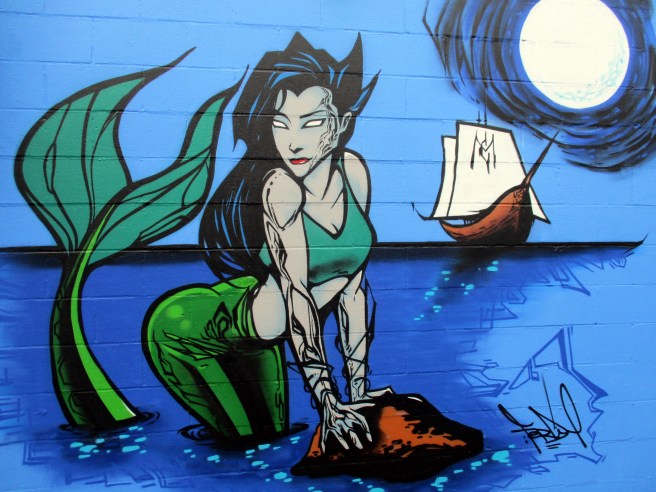
Mermaid Miraculous Creations Mural

“Often when I write poetry I don’t quite know what I’m saying myself. I mean, I can’t restate the poem. The meaning of the poem is the poem.”

“I think parts of my soul have been saved by my writing, not in the sense of escaping death, but escaping the death of the moment, perhaps.”

“I see my poems as interlinked. No poem gives an answer. It may offer other questions, it may instigate other questions that then become poems.”

“Poetry is very playful with language. I think all poetry, at its heart, is playful. It’s doing unusual and playful things with the language, stirring it up. And prose is not doing that. Primarily it’s not attempting to do that.”

“I have thought for many years that the audience any creative writer imagines has a great effect on what gets written.”

“I’ve spent much of my life being attuned to watching for an image or a phrase that can trigger what might be a poem – could become a poem.”

“I approach writing a poem in a much different state than when I am writing prose. It’s almost as if I were working in a different language when I’m writing poetry. The words – what they are and what they can become – the possibilities of the words are vastly expanded for me when I’m writing a poem.”

“In poetry I can let the language go, allow an image that seems out of place to enter and see what happens, always listening to the music that’s being created, just like the world around us, never predictable, always shifting and intertwining, reflecting and echoing itself.”

“Poetry doesn’t function by saying things straightforwardly because the language is too imprecise, too limited often, to address the underlying subject of most poems.”

“From the beginning, I felt that I didn’t ever want to leave the impression that the process of writing a poem is totally mysterious. I couldn’t explain everything that went on in the creation of a poem, but I could try to explain as much as I knew. I thought readers deserved that. I didn’t want to set myself apart as being someone special.”

—Pattiann Rogers


An Experiment Repeated (Rereading Old Notebooks and Resurrecting Forgotten Poetry)

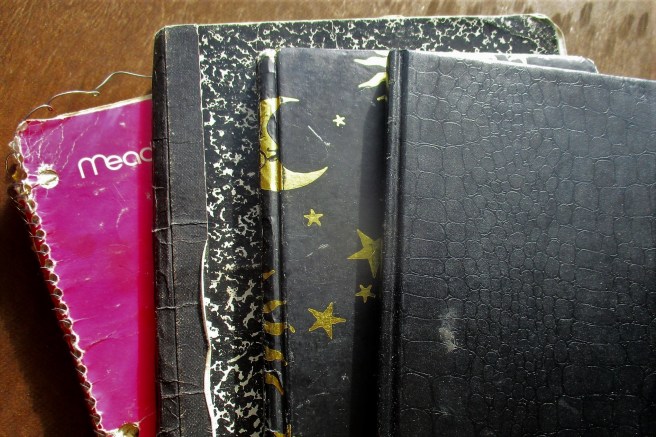
001 (2)

Last year on this very date, I decided to go through my massive collection of old notebooks and journals filled with poems I penned, find an old poem I totally forgot about, and attempt to give it a new chance at life by publishing it on this blog. This is a practice I would encourage every writer to try at least once. Though revisiting your past words might prove to be quite embarrassing, it also helps track your progress as a writer. On this first anniversary of that post, I’ve chosen to repeat that experiment, settling on an even older piece which I estimate is about 25 years old. Rereading the following has proven extremely illuminating to me, showing me how much my writing has changed (and hopefully improved). Back then I was writing strictly in free verse, not yet having developed my fanatical obsession with weird poetry forms. Also slam poetry was a definite influence on me, although I didn’t really care much for that style (I still don’t), but it seemed like during that time slam poetry was the only type of open poetry readings that were happening in my area (the line about “greater Providence” is a reference to AS220 in Providence, Rhode Island which hosted a slam poetry venue I frequented). As a result, I heard a lot of angst-filled rants and I remember this poem being an attempt to parody that type of poetry even though it probably wasn’t much better than what it was trying to satirize. Truthfully, I don’t even think this poem is all that terrible. I sort of rather enjoy the building and construction metaphor which I later recycled in what I believe was a much more successful poem. Still, like its title indicates, it probably is an example of fairly bad poetry. But I am not sure, so please let me know what you think:

In Celebration of Really Bad Poetry

There is enough venom in my veins
to poison greater Providence

(or at least make their spirits sick)
and I have bled all over this verse,

flooding the foundation with
an ocean of my insecurities.

The previous metaphor
was so poorly mixed,

the whole damn construction
is structurally unsound,

and ought to be condemned.
So unsuspecting reader,

be forewarned, do not seek shelter
in this poem so full of holes,

the similes like a leaky
ceiling drip incessantly,

disturbing this slumber
I once thought was my life.

The Third in a Series of Beau Présents Written for My Favorite Poets

new olympus pictures 260b (2)

This third in a series of beau présents for my favorite poets was written in tribute to a poet I have adored since childhood, Ogden Nash. Because beau présents are composed only of words made up from the letters contained in the person’s name, I decided to expand the vocabulary I could use by utilizing his full name (did you know his first name was actually Frederic?). They say imitation is the sincerest form of flattery so I have attempted to copy his familiar style with rhymes and irregular lines. I’m afraid the poem that resulted may just be nonsense, but hopefully, as fun to read as it was to write:

A Beau Présent For Frederic Ogden Nash

Frederic Ogden Nash
carried no foreign cash

(no francs, dinars, or Danish coins in his coffers),
ignoring his French granddad’s condescending offers

of finance,
and offended France.

10 Great Quotes About Poetry and Writing by Naomi Shahib Nye

DSCN1120 (3)

“A poem is a cup of words open to the sky and wind in a bucket.”

“Read poems both like and unlike the ones you might write. Read widely, voraciously, open-heartedly. Read work by “others”—however you might define them. If you are a young poet, read work by older poets and vice versa. If you are urban, read poems by rural writers. Obviously, read poems by writers of other ethnicities, religions, etc.”

“The poem is not a closed experience, it remains open. It invites you in, hopefully.”

“For me, the writing process is something related to like exercising your body, taking a walk, stretching. It’s better if you do it on a regular basis. You won’t be as stiff, so all my life I’ve tried to write every day. It doesn’t have to be great. Doesn’t have to be even good. Just keep that pen rolling. Write down you know, whether you’re writing a journal of what’s been happening during the day or signs you saw that day or conversations you overhead.”

“Poetry [is] more necessary than ever as a fire to light our tongues.”

“More of childhood is poetry than adulthood will ever be. For children, the land of metaphor is still very close, very rich and available. Too much analysis of the dry kind ostracized generations of readers. No one listens to a jazz concert and goes out into the parking lot to analyze it. We bask. More basking in poetry has always been needed.”

“The act of writing itself often leads us into thinking in a larger, more universal way, after focusing on or breathing with, beginning with, something grounded and close. A poem “blurs” into that larger space of being on its own, if it is lucky. There is often a little “click” or “shiver” in a poet’s mind, I think, when an experience or a perception begins opening up into something larger – one can feel this during the act of writing, sometimes, or sometimes just as thoughts and images are gathering in the mind. Sometimes there is an impulse of something large first but we have no idea what it is until we begin writing through the scene itself, the details at hand.”

“If a teacher told me to revise, I thought that meant my writing was a broken-down car that needed to go to the repair shop. I felt insulted. I didn’t realize the teacher was saying, ‘Make it shine. It’s worth it.’ Now I see revision as a beautiful word of hope. It’s a new vision of something. It means you don’t have to be perfect the first time. What a relief!”

“I do think that all of us think in poems.”

“Anyone who says, “Here’s my address, write me a poem,” deserves something in reply. So I’ll tell you a secret instead: poems hide. In the bottoms of our shoes, they are sleeping. They are the shadows drifting across our ceilings the moment before we wake up. What we have to do is live in a way that lets us find them.”

— Naomi Shahib Nye