The Streetbeatina Revisited…

IMG_20200705_221801

A little more than a year ago, I published a post on the Streetbeatina, a poetry form I originally created to celebrate the fifth anniversary of the Street Beat, an amazing open poetry reading series  that was ran and hosted by Anne Marie Lucci, a talented local poet, in my hometown of Worcester, Massachusetts for many years. At the time, since three of my streetbeatinas, along with a short history and explanation of the form, was just published in a prestigious online literary journal called Radius: Poetry From the Center to the Edge, I decided it probably wasn’t proper etiquette to republish those 3 poems or go into much details on how to write the form on this blog and instead just posted a link to the original publication on radiuslit.org. However I feel enough time has now passed to revisit the Streetbeatina and give instructions on how to write one using those 3 original poems as examples:

The streetbeatina is an eight line poem with each line consisting of eight syllables. What makes this form both a challenge to write and uniquely different from other forms is that the first syllable of the first line is repeated as the second syllable in the second line, the third syllable of the third line and so on, the repetition of the sound of the syllable at precise intervals providing the poem with a natural beat and musicality. Although it is completely optional,  the poet can emphasize the repeated syllable by either printing it in italics, bold, or a different color.

Three Streetbeatinas by Paul Szlosek *

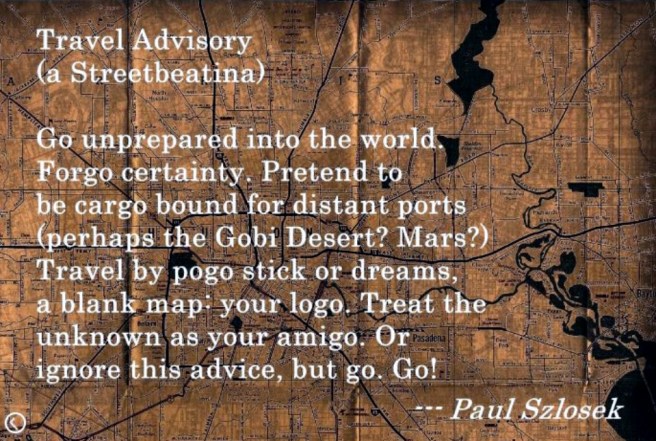
Travel Advisory

Go unprepared into the world.
Forgo certainty. Pretend to
be cargo bound for distant ports
(perhaps the Gobi Desert? Mars?)
Travel by pogo stick or dreams,
a blank map: your logo. Treat the
unknown as your amigo. Or
ignore this advice, but go. Go!

A Message to a Married Middle-Aged Man
in Middle-Management in Mid-Life Crisis With Artistic Ambitions 

So few chances to start over,
go solo, cover past mistakes
with gesso, paint a new version
of your life (sophisticated,
worldly, yet also real) like a
truly virtuoso artist
living in a loft in Soho.
to replace one that’s just so-so.

Ghost Story

Local legends say if you go
solo into the deep dark woods
when the lotus blossom first blooms,
and the moon’s low in the night sky,
the girl in yellow will appear,
her lips mouthing “Hello, my love”
while lunar light spills like lotion
on skin translucent as jello.

*(Originally published by Radius: Poetry From the Center to the Edge )
10 Great Quotes About Poets, Poetry, and Writing by Denise Duhamel

IMG_20200704_025451

“In almost every book I’ve written, there is a reference to a movie – legendary films, actors and actresses, and forgotten made-for-TV movies. The leaps poems make are not unlike the cuts in a film. The miniature and avant-garde prose poets have perhaps the most obvious ties to film, as a prose poem in its shape is not unlike a movie screen.”

“I believe it’s impossible to write good poetry without reading. Reading poetry goes straight to my psyche and makes me want to write. I meet the muse in the poems of others and invite her to my poems. I see over and over again, in different ways, what is possible, how the perimeters of poetry are expanding and making way for new forms.”

“What has stayed true in my life as a writer is my dedication to writing – I try to write every day, no matter what – and the joy that writing has given me.”

“The “biggest” poems I ever made are based on the psychological principal of the “Johari Window:” what the self freely shares with others; what the self hides from others; what others hide from the self; and what is unknown to the self and others.

“Writing is performative – and while, yes, the words in essence will be there “forever,” poems are often about ecstatic moments rather than trying to pin down a particular truth of an event.”

“The “truth” is the poem itself. Just because someone writes a poem about a feeling she has does not mean that the feeling will stay forever. The truth of the emotion of the poem remains, even if the particular truth of the poet changes.”

“I don’t know if there are topics that I unconsciously avoid, but as soon as they pop up in my writing, I try to take on those topics, whether or not I publish the poems.”

“Over the years, I became more and more interested in the forms and techniques in which things could be said.”

“My advice to my younger self would have been, ‘Chill. Concentrate on the poems. Everything else will work itself out.’ “

“I know writers for whom the act of writing is a necessary chore. They suffer to write great work. I am very lucky that for me writing is a delight.”

—Denise Duhamel

10 Great Quotes About Poets, Poetry, and Writing by Stephen Dunn

IMG_20200606_050259

“All good poems are victories over something.”

“Poetry does so many different things, it’s difficult to say anything definitive about its role, which of course varies from culture to culture. It can range from being stories of the tribe to the private lyric, to being as W.H. Auden said “the clear expression of mixed feelings” to nonsense verse. “

“I don’t let a poem go into the world unless I feel that I’ve transformed the experience in some way. Even poems I’ve written in the past that appear very personal often are fictions of the personal, which nevertheless reveal concerns of mine. I’ve always thought of my first-person speaker as an amalgam of selves, maybe of other people’s experiences as well.”

“And the words we find are always insufficient, like love, though they are often lovely and all we have.”

“If the motive of writing is for some people a kind of exercise in dirty laundry, that’s one thing. I’ve always thought of my poems as meant to be overheard, as I think all of these poems are. It seems to me if you get experience right, even your most painful or humiliating experiences – if you get those experiences right for yourself and make discoveries as you go along and find for them some formal glue – they will be poems for others.”

 “A good many of my poems over the years have alluded to or taken on the political. Stevens has a line in one of his essays: “Reality exerts pressure on the imagination.” Inevitably what is omnipresent in the culture exerts its pressure on our imaginations to respond to it, even if indirectly. But in this case the backdrop of 9/11, coincident with the breakup of a marriage, the finding of new love, some kind of personal cataclysm… all of those were forces informing the poems in some way. “

“I wrote poetry for seven or eight years, maybe longer, before I could say I was a poet. If people asked, I’d say I wrote poetry; I wouldn’t go further. I was in my mid- to late-thirties before I felt that I was a poet, which I think meant that I had begun to embody my poems in some way. I wasn’t just a writer of them. Hard to say what, as a poet, my place in the world is. Some place probably between recognition and neglect.”

“Perhaps basketball and poetry have just a few things in common, but the most important is the possibility of transcendence. The opposite is labor. In writing, every writer knows when he or she is laboring to achieve an effect. You want to get from here to there, but find yourself willing it, forcing it. The equivalent in basketball is aiming your shot, a kind of strained and usually ineffective purposefulness. What you want is to be in some kind of flow, each next moment a discovery.”

“There’s a certain pleasure in violating the strictures of your education. The trick is, if you’re going to explore ideas in a poem, to be suspicious of ideas and suspicious of your own mind at the same time. It’s often a matter of orchestration and pacing. Of shaping some kind of dialectic flow.”

“The world is always somewhat vicious. I take that as a given, but at various times in various circumstances that fact will be no more than a shadow or an echo behind some poem. Other times it will be more manifest. I try to write myself into articulations of half-felt, half-known feelings, without program. I’m always working toward getting my world and, hopefully, the world outside of me into a version that makes sense of it. Viciousness requires the same precision as love does.”

—Stephen Dunn

Three Prayers & a Curse

IMG_20200527_172119

Recently, a couple of good friends of mine, the very talented poet Curt Curtin and his wife Dee O’ Connor were perusing through Curt’s  sizable collection of local poetry publications, when they came across  an interesting literary oddity. In a wonderfully generous gesture, they graciously made scans of the pages of  it, a literally forgotten chapbook of mine from 25 years ago (at least I forgot about it) and  emailed them to me. Actually I did have a vague memory of it, but had no idea that any copies still existed. I do recall it was a handcrafted miniature chapbook (consisting of just 5 poems) created from a single sheet of folded paper and entitled Four Prayers and a Curse. As I read these scans , I immediately recognized three of the poems, including one that is still in my open mic reading repetoire, but the other two has apparently been completely obliterated from my memory. Although a bit embarrassed,  I do truly find these poems somewhat amusing in a crude sort of way and feel maybe the readers of this blog might too.  So I am sharing them with you today (omitting possibly the best one “An October Benediction for Baseball Fans” to post at a more appropriate time in the Fall). Hope you enjoy them!

Three Prayers & a Curse:

The Wall Street Prayer

Oh, Almighty Dollar,
The Lord of Loot,
Shallow be thy name.
Dow in Heaven,
Forgive us our Debts,
But put the squeeze on our Debtors.
Spare us Bears
But spur on the Bulls
For Greed is Good,
Greed is Great.

For all our earthly sins
May monetary gains compensate.

Amen.

Vegas Prayer

Lord, let my faith be as steadfast
as the atheist of unshakeable will,
who wagers all against the House
that there is no House
to win a jackpot
of nothing –
nil.

Amen.

The Critic’s Prayer

Oh God, give me a critical ear
So anything that it might hear
Which I do not understand,
I’ll dismiss with a sneer,
Make sure it gets panned.
Oh God, give me a critical ear.

Oh God, give me a critical eye,
So anything that it might spy
Which I don’t particularly like,
I’ll vilify & crucify
With a verbal spike.
Oh God, give me a critical eye.

Oh God, give me a critical disease,
So anyone who won’t do what I please
Or chooses to disagree,
I’ll infect with a sneeze.
Then they’ll think just like me.
Oh God, give me a critical disease.

Amen.

A Curse for Poets and Writers
(Warning: To Be Used Only Against
Ones You Truly Can’t Stand)

May a plague of plagiarists
Descend upon your unpublished work
And feast upon your experience,
Consuming your images
Until all you have left
Is the dried-out husks of words.

10 More Great Quotes About Poets, Poetry, and Writing by Erica Jong

OLYMPUS DIGITAL CAMERA

“One writes not by will but by surrender.”

“In poetry you can express almost inexpressible feelings. You can express the pain of loss, you can express love. People always turn to poetry when someone they love dies, when they fall in love.”

“I am not quite sure how writing changes things, but I know that it does. It is indirect-like the trails of earthworms aerating the earth. It is not always deliberate-like the tails of glowing dust dragged by comets.”

“It is for this, partly, that I write. How can I know what I think unless I see what I write.”

“Poetry is the language we speak in the most terrifying or ecstatic passages of our lives. But the very word poetry scares people. They think of their grade school teachers reciting ‘Hiawatha’ and they groan.”

“When I’m sitting at the desk not being able to write line one, it’s silence and despair! It’s not so easy to put the pen to the legal pad or type the first sentence on the computer screen.”

“I guess the thing that I’m most proud of is that I kept on writing poetry. I understand that poetry is sort of the source of everything I do. It’s the source of my creativity.”

“Often I find that poems predict what I’m going to do later in my own writing, and often I find that poems predict my life. So I think poetry is the most intense expression of feeling that we have.”

“I went for years not finishing anything. Because, of course, when you finish something you can be judged…I had poems which were re-written so many times I suspect it was just a way of avoiding sending them out.”

“It’s easier to write about pain than about joy. Joy is wordless.”

—Erica Jong

10 Great Quotes About Poets, Poetry, and Writing by Erica Jong

IMG_4472

“We write poems as leaves give oxygen – so we can breathe.”

“You are always naked when you start writing; you are always as if you had never written anything before; you are always a beginner. Shakespeare wrote without knowing he would become Shakespeare.”

“I never became a writer for the money. I am a poet first. Even getting published is a miracle for poets.”

“What are the sources of poetry? Love and death and the paradox of love and death. All poetry from the beginning is about Eros and Thanatos. Those are the only subjects. And how Eros and Thanatos interweave.”

“Critics write out of intellectual exercise, not poets. Poets write straight from the heart.”

“If you imagine the world listening, you’ll never write a line. That’s why privacy is so important. You should write first drafts as if they will never be shown to anyone.”

“Nothing you write is ever lost to you. At some other level your mind is working on it.”

“It takes a spasm of love to write a poem.”

“What makes you a poet is a gift for language, an ability to see into the heart of things, and an ability to deal with important unconscious material. When all these things come together, you’re a poet. But there isn’t one little gimmick that makes you a poet. There isn’t any formula for it.”

“Poetry . . . comes blood-warm straight out of the unconscious.”

—Erica Jong

A Tribute Written For One of My Favorite Poets (That Is Not a Beau Présent)

OLYMPUS DIGITAL CAMERA

You may be familiar with my series of beau présents recently written as tributes to my favorite poets that I have been posting on this blog lately. Well, the poem I am posting today is not part of that series; it is definitely not a beau présent, anf not actually in any specific poetry form per se (though it  was certainly written in a style meant to emulate the poet I was attempting to honor: E. E. Cummings). The following poem was written over 20 years ago when Peter Mancevice, the publisher of a local poetry journal called Sahara, approached poets in the Worcester, MA area (including myself), asking them to write and submit poems about their favourite poets and the reasons why they liked them for a planned special issue. Apparently there wasn’t a sufficient amount of submissions, and this special edition of the journal never came to fruition. However, Peter did graciously end up publishing my response to his request in their Spring/Summer 2001 issue.  I must note that my poem was first written with very unusual spacing and line breaks in an attempt to imitate Cummings, but unfortunately I found WordPress is unable to preserve the original typography, thus the version you will be reading here has more conventional spacing and lines. Also the first and last lines intentionally reference two of my favorite Cummings’ poems : i like my body when its with your body and somewhere i have never travelled, gladly beyond.

Here is my poem (I hope you will enjoy it):

why i like reading e. e. cummings

i like my mind when it’s with his mind,
stumbling, sprinting, gliding across a page,
leap-frogging over careening commas,
side-swiping semi-colons; slamming
into unexpected periods. i like zag-zigging
thru an obstacle (of) course of typography
of cntrctng e x p a n d i n g new-ly cooly minted
words scattered splattered here there everywhere –
comprehension slowly sure-ly shifting
from singular difficulty to double “e”s.

nobody, not even an optician from lilliput
clutching his tiny eye chart, has such small “i”s.

—Paul Szlosek

10 Great Quotes About Poetry, Writing, and Art by Johann Wolfgang von Goethe

IMG_20200415_062209

“What makes poetry? A full heart, brimful of one noble passion.”

“After all, poets shouldn’t be their own interpreters and shouldn’t carefully dissect their poems into everyday prose; that would mean the end of being poets. Poets send their creations into the world, it is up to the reader, the aesthetician, and the critic to determine what they wanted to say with their creations.”

“Writing is busy idleness.”

“True art can only spring from the intimate linking of the serious and the playful.”

If you want to understand poetry, you have to go to its origin. If you want to understand the poet, you have to go to the poet’s home.

“Personality is everything in art and poetry.”

“The question “From where does the poet get it?” addresses only the what, nobody learns anything about the how when asking that question.”

“He who does not expect a million readers should not write a line.*

“Give shape, Artist! Don’t talk! Your poem be but a breath.”

“No concrete object lies outside of the poetic sphere as long as the poet knows how to use the object properly.”

—Johann Wolfgang von Goethe

10 Great Quotes About Poets, Poetry, and Art by Edith Sitwell

012

“The poet is the complete lover of mankind.”

“Poetry ennobles the heart and the eyes, and unveils the meaning of all things upon which the heart and the eyes dwell. It discovers the secret rays of the universe, and restores to us forgotten paradises.”

“In the Augustan age … poetry was … the sister of architecture; with the romantics, and their heightened vowel-sense, resulting in different melodic lines, she became the sister of music; in the present day, she appears like the sister of horticulture, each poem growing according to the law of its own nature.”

“I may say that I think greed about poetry is the only permissible greed – it is, indeed, unavoidable.”

“Isn’t it curious how one has only to open a book of verse to realise immediately that it was written by a very fine poet, or else that it was written by someone who is not a poet at all. In the case of the former, the lines, the images, though they are inherent in each other, leap up and give one this shock of delight. In the case of the latter, they lie flat on the page, never having lived.”

“As for the usefulness of poetry, its uses are many. It is the deification of reality. It should make our days holy to us. The poet should speak to all men, for a moment, of that other life of theirs that they have smothered and forgotten.”

“Art is magic, not logic. This craze for the logical spirit in irrational shape is part of the present harmful mania for uniformity.”

“My poems are hymns of praise to the glory of life.”

“The poet is a brother speaking to a brother of “a moment of their other lives” – a moment that had been buried beneath the dust of the busy world.”

“All great poetry is dipped in the dyes of the heart.”

—Edith Sitwell

The Fourth in a Series of Beau Présents Written for My Favorite Poets

Red Mill2

This fourth in a series of beau présents written for my favorite poets is meant as a tribute to probably my ultimate fave – the one and only Thomas Lux (in case you haven’t read my previous posts on the form, the beau présent is an usually brief poem composed to honor a person that consists of only words formed from the letters in their name):

A Beau Présent For Thomas Norman Lux

Thomas Lux’s a natural author,
a most moral man (not a trashman
nor a smut mouth, not rash nor lax,
not sour nor ho-hum), a smooth
orator, an ultrasmart annotator,
a solo astronaut, a tutor to lost tarantulas.

Thomas Lux has an autonomous soul,
uses humor to summon truth
& rout out rumor, shouts out
marathon rants to taunt & harass
amoral morons, louts, & trolls,
or to honor an oath to mutual human trust.
.
Thomas Lux’s as hot as arson,
as sonorous as a sonata on an alto sax.
Lux’s our mantra, our motto, our north,
our south, our moon, our sun, our stars,
our sultan, our tsar, our start, our last
hurrah, our utmost, our total – our all!